
More than 240 students applied to spend a weekend building with no sleep and a 24-hour clock.
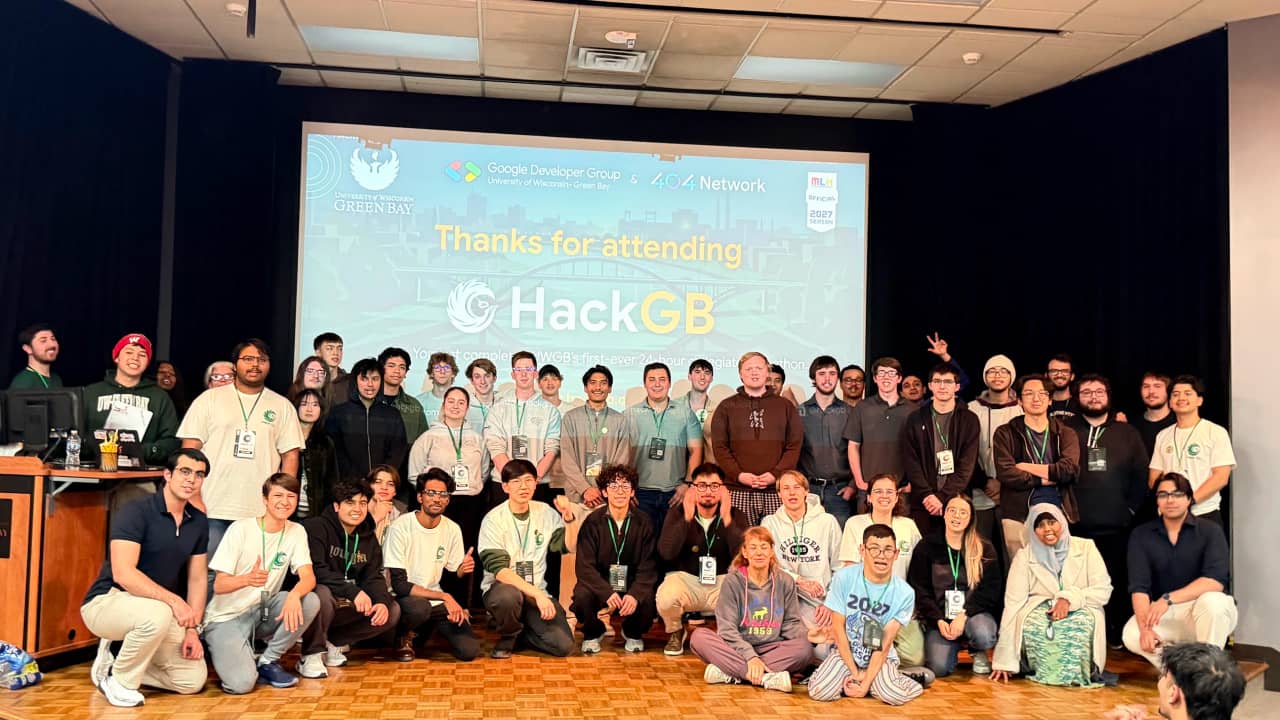
Fifty-eight of them showed up in person. Roughly three out of four had never been to a hackathon before.
In 2026, you'd expect that crowd to turn out a pile of AI wrappers. Type a prompt, get an app, demo it, go home. That's not what happened at HackGB.
On October 17 and 18, UW-Green Bay hosted its first collegiate hackathon at the Brown County STEM Innovation Center. Google Developer Groups on Campus UWGB organized it with 404 Network, and Major League Hacking came on as the member-event partner. Startup Wisconsin was one of the sponsors helping get the word out.
Counting organizers, volunteers, judges, mentors, speakers, and sponsors, more than 100 people filled the building. Students came from UW-Green Bay, Fox Valley Technical College, Milwaukee School of Engineering, UW-Milwaukee, UW-Madison, Knox College, and more. They turned in 24 projects across four tracks: education, healthcare and wellness, environment and sustainability, and industrial.
Almost every team used AI. The teams that won mostly used it to build faster, then spent a lot of their 24 hours making sure it couldn't make the important calls on its own.
Why does Green Bay need its own hackathon?
Sachin Shrestha has been to hackathons at Princeton, Carnegie Mellon, UIUC, UW-Madison, and more. He's a final-year computer science student at UWGB, founder and president of GDG on Campus UWGB, and HackGB's lead organizer. He and his friends kept coming home from those events asking the same question: why couldn't students have this in Green Bay?
“I love traveling to other universities for hackathons, but not every student can do that. Travel costs money, takes time, and can be intimidating when it's your first event.”
- Sachin Shrestha, Lead Organizer, HackGB 2026
So a group of students spent months on sponsor outreach, wrangling two campus buildings, recruiting judges and mentors, and figuring out food and overnight logistics for an event none of them had run before. Sachin led it with fellow lead organizers Carlos Guzman, Sumit Karki, and Pitambar Pandey, plus organizers Saksham Yadav, Sweta Shrestha, Maimoona Khan, Shivam Agrahari, Eugene Singh, Alex Ritt, Bishal Adhikari, Smriti Subedi, Preshak Bhattarai, Ethan Wollert, and Jack London.

The point was never to copy a big-school hackathon. It was to show students you don't need to be an experienced programmer or go to a big-name school to build something meaningful.
Who won at HackGB 2026?
- Best Overall Hack: Cold Guard, an intrusion protection system for refrigeration equipment, built by Conner Claiborne and Mushub Arab
- Best Healthcare & Wellness Hack: CheckMate, a bilingual ER check-in kiosk that catches duplicate patient charts, built by Ivan Flores and Alejandro Barojas
- Best Environmental & Sustainability Hack, Best Hardware Hack, and Best Use of Tiger Data: ReHome, which turns one photo of an unwanted item into a resale listing or a donation match, built by Alan Beardsley, Shuja Waraich, Shayan Rehman, and Ibrahim Mansoor
- Best Industrial Hack and Best Use of DigitalOcean: EyesUp, which uses computer vision to check that machine operators are alert, built by Hunter McDaniel, Silverio Mirao, Owen Kromrey, and Aaron Fraser
- Best Education Hack: MathWise, which checks handwritten precalc and calculus line by line and lets students pick how much help they get, built by Sanghyeon Han and Bibash Chaudhary
- Best Solo Hack and Best Use of Modal: AirSketch, a lecture workspace where you write on live video with hand gestures and get auto-generated notes and quizzes, built by Lenin Goud Athikam
- Best UI/UX Hack: MedCheck, a phone app that reads medicine labels and shows caregivers which ones share an active ingredient, built by Debit Bhattarai, Bibesh Pyakurel, and Himal Subedi
- Best Beginner Hack: Gunk Radar, a 3D map of industrial pollution in Eastern Wisconsin cities, built by Samundra Pathak
- Best Use of Lovable: WheelScares.com, a guide to accessible paranormal and haunted attractions, built by Benjamin Villalovas
- Best Use of Vultr: FoxWatch, algal bloom detection for the Fox River and the bay, built by Austin Koske, Miles Trompeter, Peter Kwaterski, and Ava Latoria
- Best Use of Solana: ProofSettle, which helps manufacturers and suppliers settle damaged-shipment disputes, built by Kishan Kota, Michael Hallam, Evan Juszczak, and Luis Camilo Alvarez Carrau
- Best Use of Gemini API: CodeClash, ranked 1v1 coding duels plus an AI tutor that only asks questions, built by Bryce Krause, Samuel Anderson, David Desing, and Robert George Vorobchevici Condria
- Best Domain Name from GoDaddy Registry (pending confirmation): Sus or Safe, interactive lessons that teach people of all ages to stay safe online, built by Nadija Lohja, Hui Lee (Cindy), John Lathrop, and Shaima Farah
How did the winning teams use AI?
Carefully. Over and over, the writeups describe the same design move: let the AI read, draft, and explain, but keep the actual decision in plain code or in a human's hands.
The organizers noticed it too. AI tools were allowed, and judges paid attention to whether teams could explain where AI helped and where they still needed real logic or a person making the call.
“We weren't trying to reward whoever generated the most code. The goal was to build something that worked and could solve a real problem.”
- Sachin Shrestha, Lead Organizer, HackGB 2026
CheckMate is the clearest example. The AI agent at the check-in kiosk can only ask to search for a chart or open a new one. It has no ability to link two records. A rules-based gate re-checks every request, and if a new patient looks like an existing chart, the check-in goes to a person at the registration desk, who sees the evidence side by side and makes the call. In their test, with the gate on, zero out of 150 returning patients got a duplicate chart. With it bypassed, all 150 did.
MedCheck built around one rule: evidence, not advice. The app never calculates a dose and never tells you a combination is safe. If it finds no shared ingredient, it says exactly that, with no green checkmark.
ReHome let its AI agents decide whether an item should be listed or donated, but only one boring, predictable piece of code is allowed to touch the database.
MathWise doesn't take the AI's word on calculus. Gemini reads the handwriting and spots the first wrong line, but a computer algebra system checks the final answer with actual math. The team added it after Gemini blamed a correct line on one of their own test problems. CodeClash built its AI tutor with one rule baked in: ask guiding questions, never hand over the code.
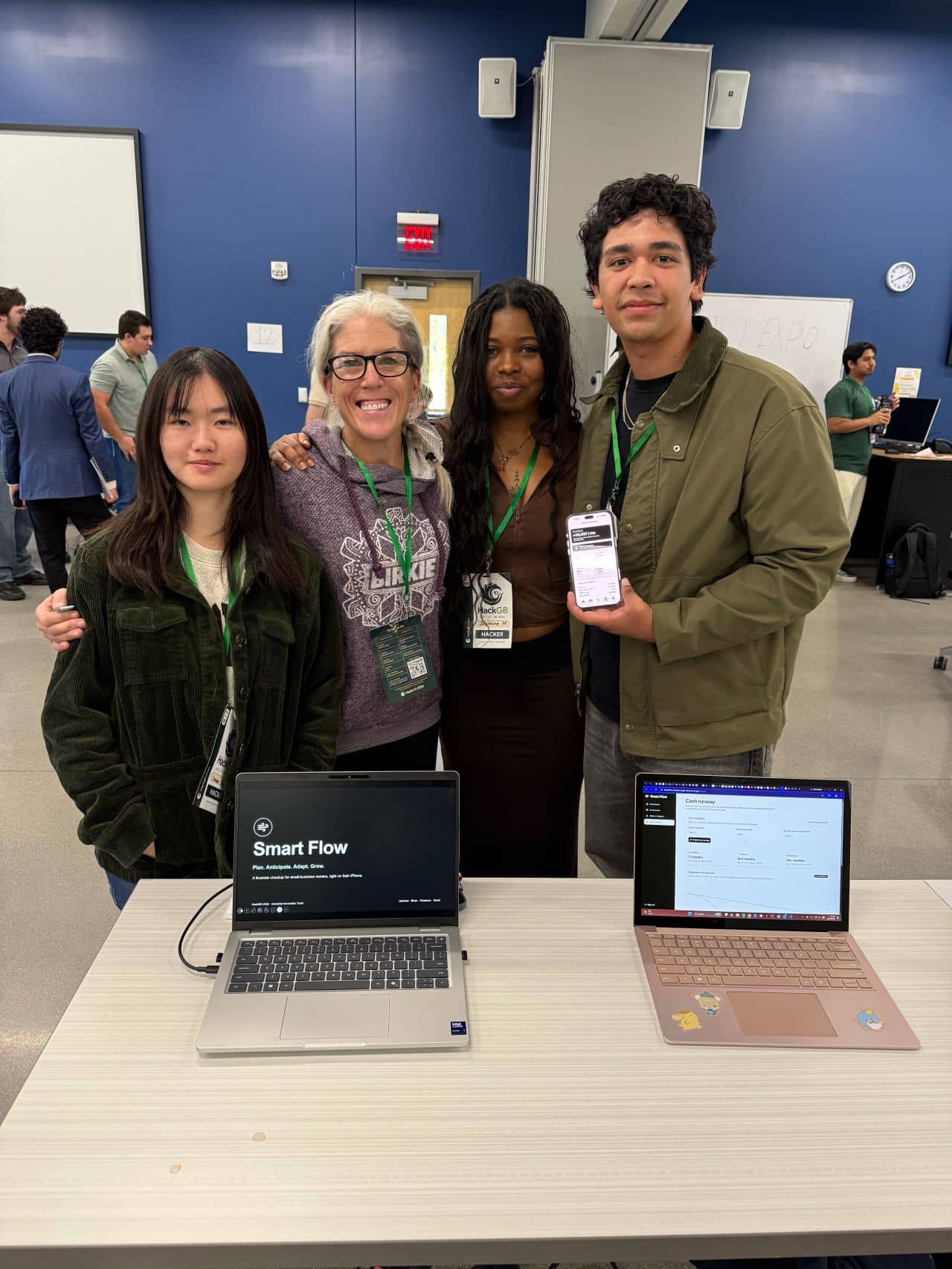
And the Smart Flow team, building a cash-flow checkup for small businesses, put it about as plainly as possible in their writeup: the AI never does the math.
FoxWatch took the same idea to environmental data. Their dashboard pulls USGS water measurements and satellite imagery of the bay, runs a bloom prediction model, and then works hard to show users what it doesn't know.
“Producing a colorful map was relatively easy. Making sure users could see where that map was uncertain was much harder and more important.”
- FoxWatch team, HackGB 2026 project writeup
That's a lesson plenty of funded startups are still learning.
Why did a refrigeration hack win best overall?
Because it solved a real, unglamorous problem that's hard to fix any other way.
Cold Guard's team pointed to a reported attack on the refrigeration systems of roughly 700 French supermarkets, where older equipment running protocols with no authentication got hijacked. Stores can't easily rip out and replace that hardware. So Cold Guard sits in line between the controller and the PLC and blocks malicious commands before they land.
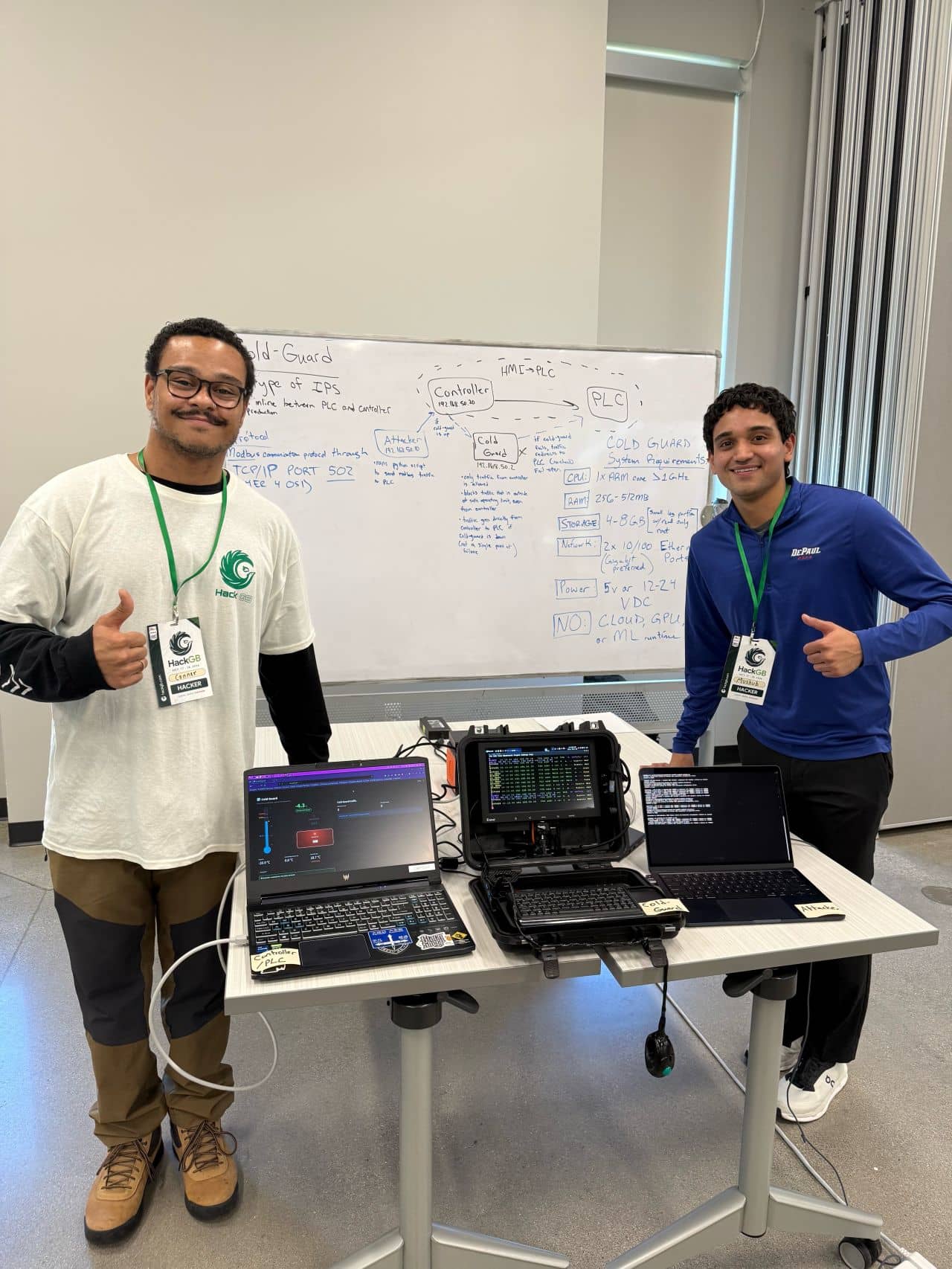
Conner Claiborne studies cybersecurity and asset protection at Fox Valley Technical College. The winning project at UW-Green Bay's hackathon came partly from a tech college student working on industrial infrastructure. In a state that runs on food processing, cold storage, and manufacturing, that tracks.
Did teams build for Northeast Wisconsin?
That was the plan. The organizers added an industrial track on purpose, because manufacturing, engineering, and field services are such a big part of Northeast Wisconsin. They wanted students working on local industry problems right alongside more familiar software ideas.
It worked.
- EyesUp, the Best Industrial Hack, uses computer vision to check whether machine operators are alert, and another team with foundry backgrounds built interactive safety training to replace the videos and paperwork they sat through on the job.
- FoxWatch is built for the Fox River and Green Bay, with "X-Ray the Bay" satellite estimates checked against real research-vessel measurements.
- Gunk Radar maps the top industrial polluters in Green Bay, Manitowoc, Sheboygan, and Milwaukee using EPA data.
- Smart Flow was designed with small manufacturers in Northeast Wisconsin in mind, where material prices and uneven customer payments can flip a month from profit to loss.
- Hooked came from someone who works in IT for a school district and noticed students get phished through texts and DMs, not the email scams most training covers.
- And yes, someone built a UWGB parking app, complete with snow removal alerts. Of course they did.
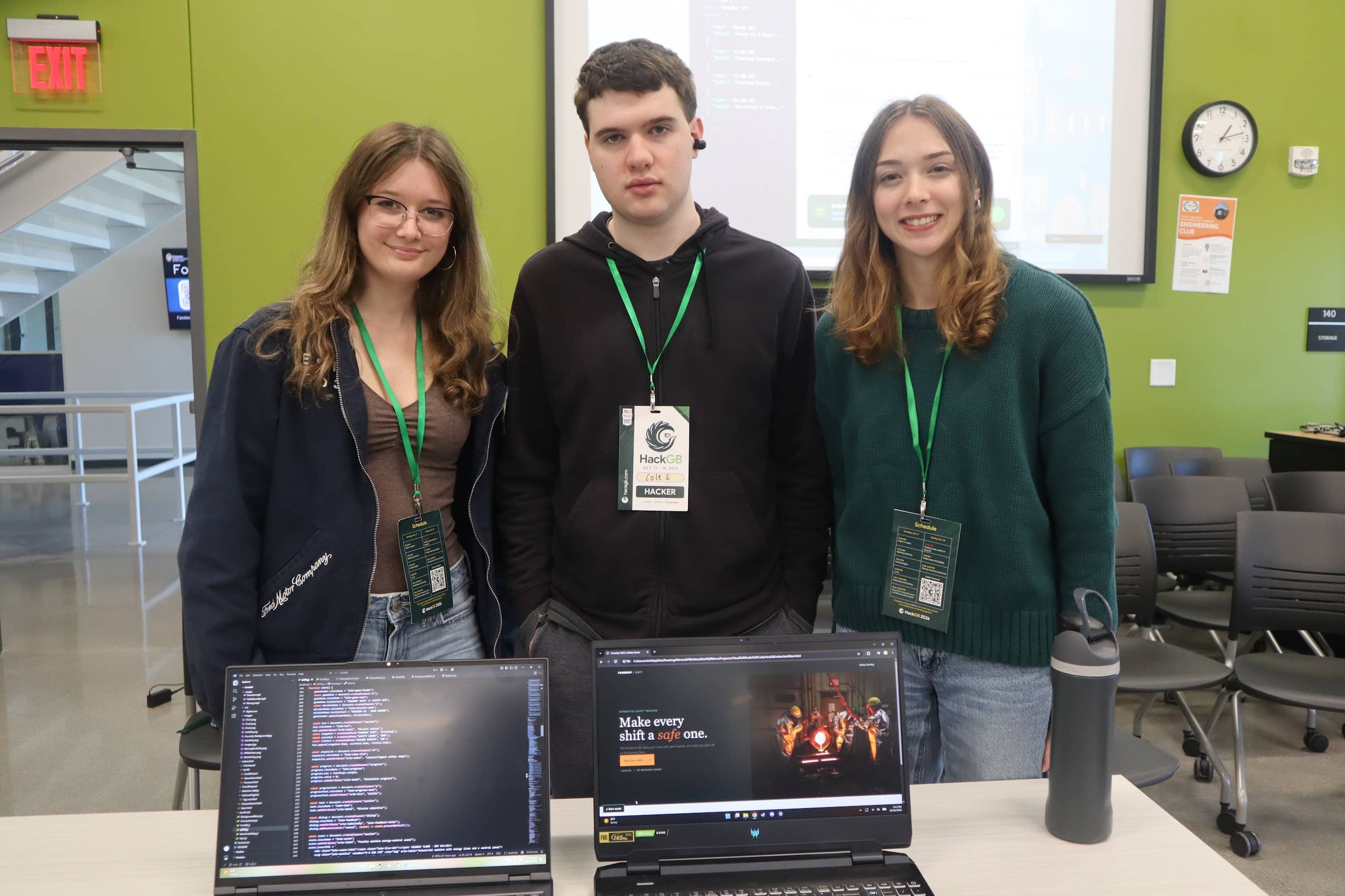
None of these are generic "AI for X" pitches. They came from people who know the river, the factory floor, or the school district because they live and work there.
What about first-time builders?
They were most of the room. Roughly 75 to 80% of the students at HackGB had never been to a hackathon.
Benjamin Villalovas was one of them. He came solo, built WheelScares.com around his own love of paranormal places and the real problem of finding attractions that are actually accessible, and won Best Use of Lovable. When we asked Sachin which project surprised him most, it was Benjamin's.
“It reminded me that a meaningful project doesn't have to be the biggest or most technically complicated one. Sometimes it's something personal that someone finally gets the opportunity to make.”
- Sachin Shrestha, Lead Organizer, HackGB 2026
Samundra Pathak had never built an interactive map before and used HackGB to try, with mentors nearby. That project won Best Beginner Hack. The MathWise team built a handwritten calculus checker at their first hackathon and took home Best Education Hack. And one team's writeup proudly notes that a teammate learned HTML and CSS for the first time that weekend.
Who helped the teams build?
A lot of people gave up their weekend.
Chris Chan, co-founder and CEO of Kommon AI, gave the opening keynote and later led a pitching session. Kiruthika Subramani, a Google Developer Expert in AI, traveled from Canada to run a workshop on taking an AI agent from demo to production with Google Cloud Run. Andrew Hinh from Modal covered serverless AI and cloud computing. Pat Scanlan from Bay Tek talked about turning digital game ideas into physical arcade experiences, and Harrison Mueller from Faith Technologies presented on careers and technology at FTI.
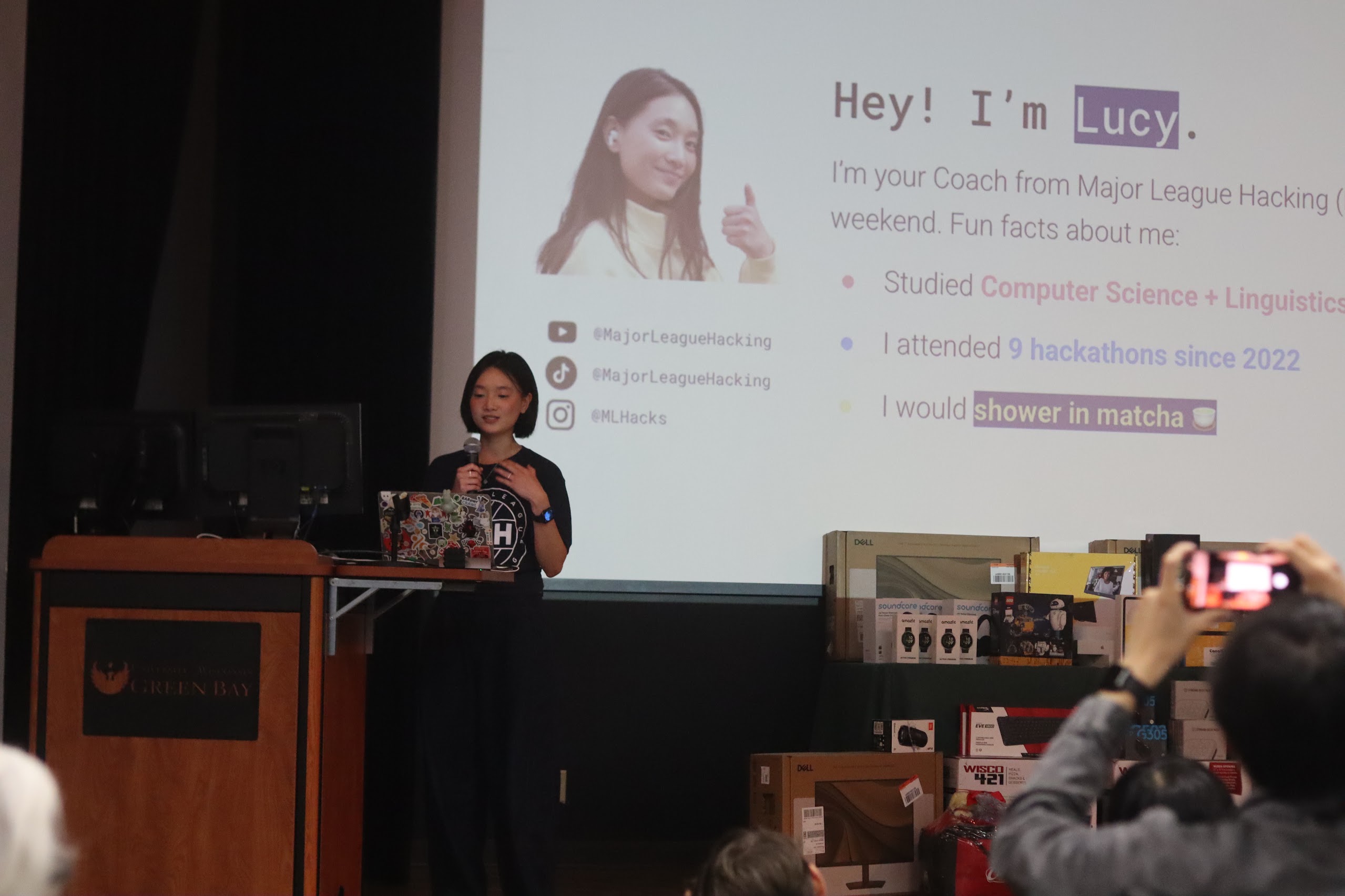
MLH coaches Lucy Wu and Wei He ran workshops and supported teams all weekend. Raffay Chaudhry, president of UWGB's Student Government Association, hosted the opening ceremony, and lead organizer Carlos Guzman hosted the closing ceremony. Industry judges and mentors worked with teams through the build and the Project Expo.
Sponsors and partners included UW-Green Bay, Google for Developers, Faith Technologies, AK Pizza Crust, Bay Tek and The Village, CDW, ATC, gener8tor, Modal, Lovable, Startup Wisconsin, the City of Green Bay, and other campus and community partners.
What happens next?
The organizers see HackGB 2026 as the start, not a one-time event. For 2027 they want more universities, more sponsors and industry partners, more mentors, and simpler logistics for participants.
The teams are already looking ahead too. FoxWatch wants to validate its predictions with researchers and agencies before expanding across Lake Michigan. Smart Flow wants to pilot with small manufacturers in the Green Bay area. MedCheck wants to test with real caregivers on their own phones.
Those next steps need people outside the university. If you work in Northeast Wisconsin, here's what helps most, straight from the organizers:
- Be a technical mentor for a team
- Introduce a team to a potential user
- Run a small pilot or give feedback from someone who knows the problem
- Offer an internship
- Sponsor, judge, mentor, or run a workshop at HackGB 2027
Start with the HackGB project gallery, find the project closest to your world, and reach out. To get involved next year, contact the organizing team through hackgb.com.
Sachin's takeaway from the weekend is that the talent is already here.
“They didn't need a huge startup ecosystem or a famous tech campus to start. They needed a place to try things, people willing to help, and a reason to get together.”
- Sachin Shrestha, Lead Organizer, HackGB 2026
Green Bay just gave 58 students that place. Let's give the best of them a reason to keep building here.