
On August 20, a Madison company called Dirac Labs announced $1.8 million in pre-seed funding to build its first sensor prototypes and take them into the field. TitletownTech led. Automotive Ventures, Riceberg Ventures, quantumEDGE Ventures, gradCapital, Jude Gomila, and Balaji Srinivasan came in alongside.
That is the number that traveled. It is also the last thing that happened.
Dirac Labs had been building for about three years before that round closed, funded the entire time by grants. An endowment fund, a philanthropic program, a federal ocean initiative run through a Wisconsin accelerator, and a state hub working with UW-Madison. None of it venture money. None of it cost the founders a share of the company.
By the time TitletownTech wrote a check, a lot of the risk had already come off the table.
What Dirac Labs is building
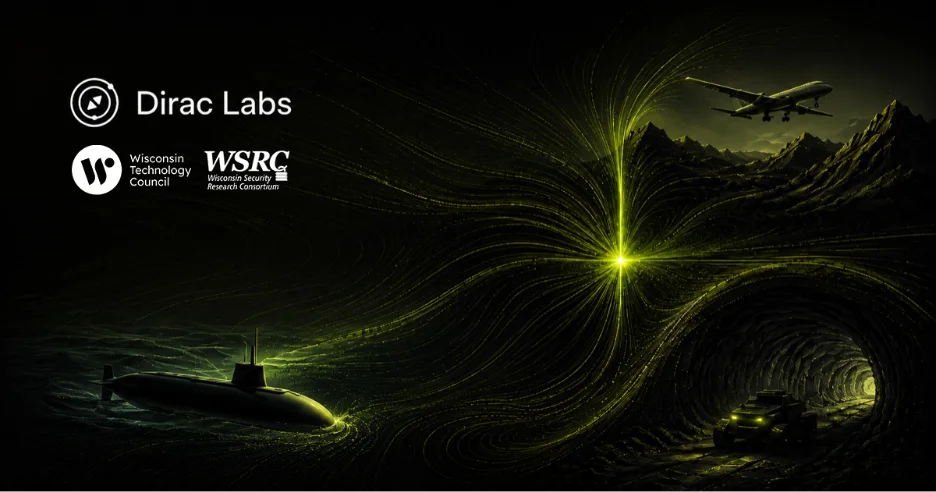
GPS signals never reached underwater or underground, and in contested airspace they can be jammed or faked. That covers a growing share of mining, subsea survey, and defense work.
So Dirac Labs stopped listening for a satellite and started reading the planet. Earth's magnetic field is already down there, and it gets stronger the closer you get to rock.
The company builds diamond-based quantum sensors that measure variations in that field, then runs the readings through machine learning models that strip out environmental noise and match the result against existing magnetic maps. Where no map exists, the sensor makes one. Combine that with inertial drift correction and you get a position without a satellite.
GPS is global, but not universal.
Sanket Deshpande, co-founder and CEO, Dirac Labs
Spoofing a GPS signal is cheap because the signal is weak, a few microwatts arriving from a satellite tens of thousands of kilometers away. Overpowering it takes almost nothing. Faking Earth's magnetic field is a different proposition. Deshpande worked through what it would take on a recent podcast appearance: the most powerful magnets ever built, the kind used in fusion reactors, mounted on a train that somehow follows an aircraft in flight. Magnetic field strength falls off with the cube of distance, so even that would not carry far enough.
The physics is not new. Quantum magnetometry has worked in labs for years. The barrier has been cost, size, and durability, meaning a sensor that holds accuracy in real conditions at a price somebody outside a defense budget can pay.
Dirac's bet is manufacturing. The sensors use engineered defects inside lab-grown diamond, which means they can be produced in the same foundries that make microchips, on roughly the same unit economics. That is the difference between a lab instrument and a product. Mikhail Kats, Deshpande's former PhD advisor at UW-Madison and now an advisor to the company, describes the market the same way: at today's cost, quantum navigation only pencils out for large defense platforms, and shrinking the sensor is what opens up autonomous vehicles and drones.
The money before the money
The US-India money did something more specific than keep the lights on. Before Dirac had a sensor to test, the team used that grant to build the machine learning systems that clean up magnetic data. The software that makes the hardware usable got built first, on money that took no equity.
De-risked by grants, where we didn't have to go out and raise money.
Aishwarya Das, co-founder and COO, Dirac Labs
Das describes the split plainly. The grants built the initial technology stack and took the technical risk out. Venture capital came in only once the demand was proven, and its job is to accelerate, not to discover whether the thing works.
Ryan Jeffery, who runs sustainability at gener8tor, made the public side of that point when the round was announced. Federal money pushed passive quantum sensing toward the ocean economy, and private investment following it is the evidence that the handoff works.
The ordering matters more than the dollar figures. Non-dilutive money buys evidence, and evidence is what makes an equity round small, late, and cheap in ownership terms. A hardware company cannot demo physics on a slide. Every month of grant-funded lab work is a month the founders are not selling equity to pay the electric bill.
Laura Strong made a version of this argument when we talked about funding alternatives for Wisconsin businesses on the podcast. The instrument you pick decides how the company ends, and most founders pick it before asking whether they want venture money at all.
Why the round closed now
Three years of grants, then a pre-seed in August. The timing is not an accident.
On June 22, President Trump signed Executive Order 14413, which puts quantum sensing on a deadline rather than a research agenda. It directs the Secretary of War to name at least three next-generation quantum sensor projects and field them by September 30, 2028, and directs Commerce to plan for the commercial readiness of quantum sensing and sensor manufacturing. The Defense Innovation Unit followed with an initiative that could put up to $200 million into moving mature quantum sensing and timing technology into operational military use within a year.
Das reads that as the moment the category became fundable. A federal deadline exists, real procurement money is attached to it, and that combination tells investors the demand is not hypothetical. She also points out what the order asks of allied supply chains, which is the part that makes an early US-India grant look less like a curiosity and more like positioning.
The map this one deal draws
Four cities touched a $1.8 million pre-seed for a company most Wisconsin founders have never heard of.
Madison built it. Deshpande and Aishwarya Das spun Dirac Labs out of UW-Madison in 2025, after Deshpande defended a dissertation on making quantum technology survive outside a lab. Das brings physics and machine learning, which happen to be the two halves of the product. Foundational IP came out of the university, and Deshpande credits continued access to its tools and scientific advice for a good share of the technical de-risking. Jennifer Choy, an associate professor at UW-Madison, advises the company.
Green Bay funded it. TitletownTech, the venture firm formed out of the partnership between Microsoft and the Packers, led the round under managing partner Jill Enos. It is the same fund that backed Realta Fusion before that company chose to stay in Wisconsin.
Chicago connected it. Dirac joined the Chicago Quantum Exchange as a corporate partner in March 2025. Deshpande describes what that bought them in practical terms: access to principal investigators across the region's universities, and a hiring line into graduate and undergraduate students at UW-Madison, UIUC, and the University of Chicago, alongside Argonne.
The region supplies it. Choy points at something easy to miss from here: the Midwest already grows domestic diamond material, and it has end markets like agriculture where autonomous equipment has to work in places the GPS signal gets patchy.
None of that infrastructure was built for Dirac Labs. It was already assembled, and a two-person spinout used all of it. Six other Wisconsin companies are doing something similar right now in the inaugural gBETA Frontier Technology cohort, including another Madison team working on quantum error correction hardware.
Wisconsin's problem was never research. It was the distance between a published paper and a company, and that distance keeps getting shorter. Jon Eckhardt has been building programs at UW-Madison aimed squarely at getting more university research to founders, and Jessica Silvaggi does the same work turning UW-Milwaukee research into startups.
What happens next
This is further along than a lab result. The team has already flown a prototype on an aircraft, wires hanging out, and used the places it failed to shape how the next version gets designed. Deshpande frames that as the whole approach: build sensors you can make thousands of, not exquisite instruments that only work on an optical table.
Military platforms come first, because that is where the cost currently works. What Deshpande describes after that is a shrinking exercise. Get the size, weight, power, and cost down far enough and the sensor ends up in anything with a GPS receiver, not replacing GPS but backing it up when it drops.
Two months after the round, Dirac Labs took a step in that direction by joining the push to make Lake Michigan the Navy's Area 52, a proposed test range for autonomous ships and submarines.
The first commercial market he names is indoor navigation. Factories, shopping malls, subways, airports, anywhere the signal never arrived and the magnetic environment is messy enough to be useful. He puts workable solutions six to twelve months out, which is a specific enough prediction to check him on.
If it works, Wisconsin has an anchor company in a category that barely exists yet. If it doesn't, the state and the federal programs spent public money finding out, which is exactly what that money is for.
Either way, the sequence is the part other founders can copy. Prove the hard thing on somebody else's money. Sell equity once it's worth something.