
Greg Tracy was cold and tired of missing his bus. So he fixed it.
This was 2010. Madison Metro's posted arrival times were often wrong, and Greg, a Madison developer, kept getting stuck at the stop for no obvious reason. His fix was a text-message service called SMSMyBus. You sent it a stop number, it sent back when your bus was actually coming.
That little side project did not stay little. It grew into a full transit API that other people built apps and kiosk displays on top of. By 2014 it was handling more than 90 million requests a year. The City of Madison gave him a Community Partnership Award. Over its lifetime, Greg estimates the thing served around a billion requests, ran for fifteen years mostly hands-off, and cost him less than three dollars a month to operate.
He shut it down this past year, on purpose, because Madison Metro finally built its own official version. A good ending.
His last words about it:
"Never stop building."
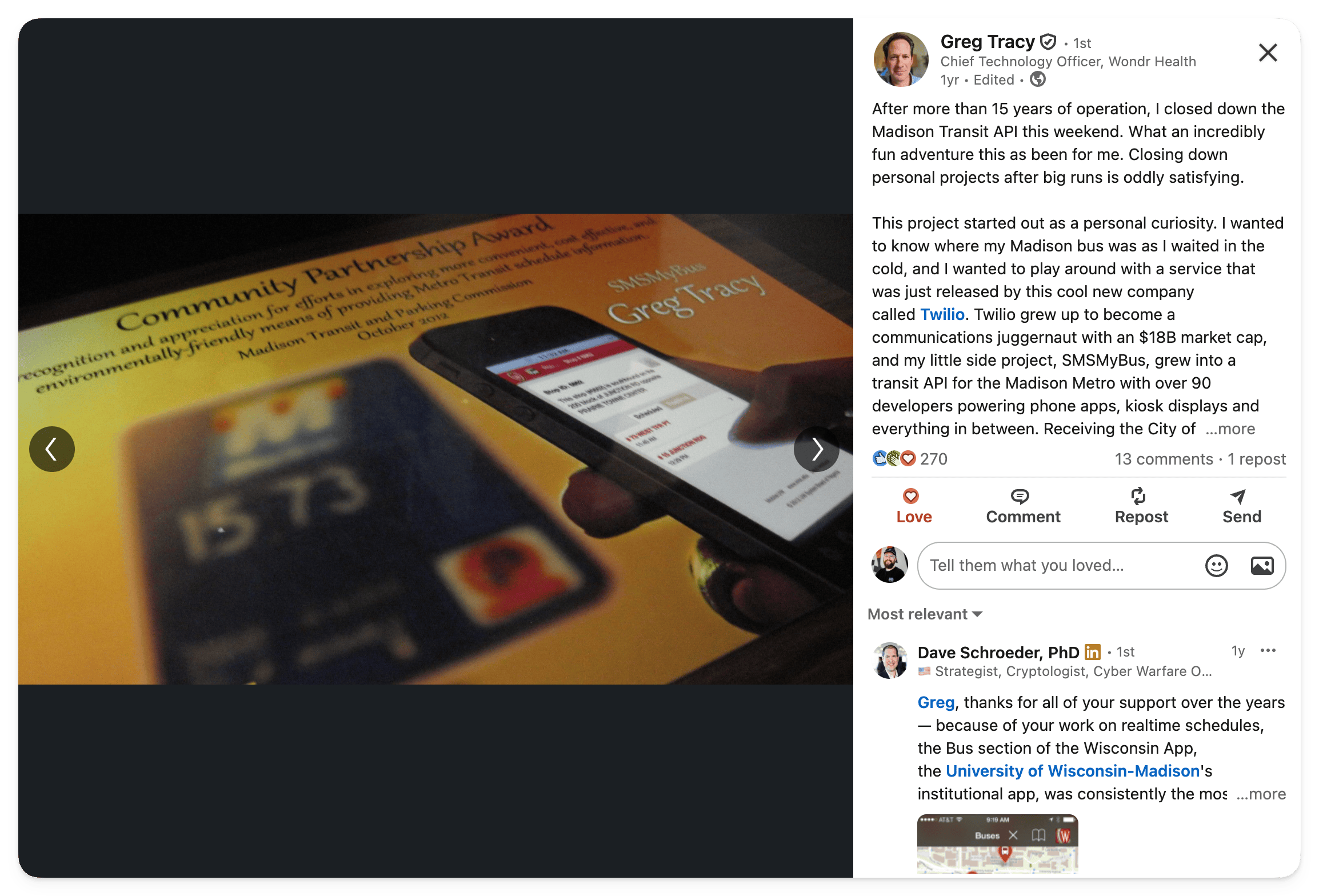
To pull that off in 2010, Greg had to be a real engineer. He scraped data off the Metro's website, stood up servers on Google App Engine, wired in a brand-new company's texting tool called Twilio, and then quietly maintained the whole thing for fifteen years. Most people who saw the same problem could never have built the same solution.
That part has changed.
The barrier has dropped
The tools that used to separate the people who notice problems from the people who can fix them are mostly gone. With AI tools like Claude Code and Lovable, someone with no formal engineering background can describe the thing they wish existed and have a working version by the end of a weekend. The hard part is no longer the building. It's caring enough to start.
Travis Erath ran that play from an unusual angle. While he was still applying for a job at the Idea Fund of La Crosse, he vibe-coded a working prototype of a talent system the job description had never asked for. He got the job, and a good chunk of that prototype is live on the fund's career site today.
And across Wisconsin, more people are starting.
Two builders who saw a gap
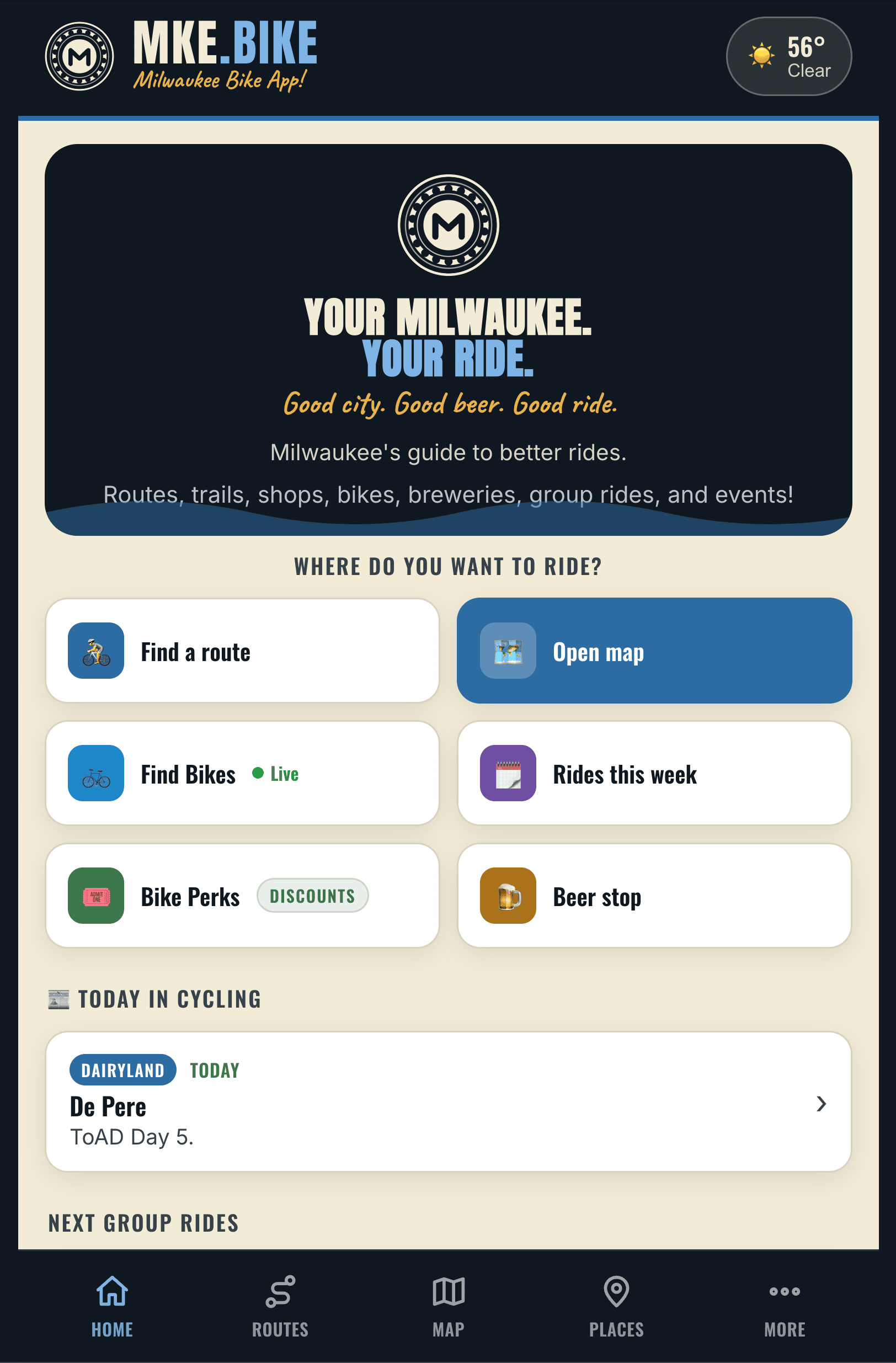
Ryan Thompson wanted Milwaukee's bike scene in one place. The group rides, the trails, the Bublr stations, the repair stands, the breweries worth pedaling to.
So he built MKE.BIKE, a free bike app with a live map, real-time Bublr availability, the week's group rides, and a way for riders to flag a pothole or a dark stretch so the next person knows about it. No download. No account. Just open it and ride.
Bryan Cayabyab hit a wall every parent in Green Bay knows. The city publishes a good summer guide for families. It's a PDF. And a PDF is useless when your kid is asking what you're doing today and you're trying to search it one-handed on your phone.
So Bryan rebuilt it as the Link Summer Guide, something you can actually navigate: camps, pools, classes, and free drop-ins across Greater Green Bay, searchable by date or area, viewable as a map or a calendar. It has a section for free summer meals for kids, every listing links back to the official source, and it works in eight languages, including Spanish, Hmong, and Somali. He built it for his own family, then realized every parent hits the same wall, so he gave it away.

Neither of them asked permission. Neither waited for a budget. They saw a gap and filled it.
The opportunity for local leaders
Why aren't more of the teams that already serve our communities building like this?
The information almost always exists. It's just trapped. Stuck on a pamphlet on a folding table, or in a PDF buried four clicks deep on a city website, where the family who needs it most will never find it. Bryan's guide didn't invent new programs. It took ones that already existed and made them findable. That's the whole trick. And it cost a rounding error next to printing stacks of brochures that end up in the recycling bin.
Greg made the same point fifteen years ago, just with harder tools. Cities and county offices and nonprofits are sitting on useful public information. When they make it easy to find and easy to share, people end up healthier, more connected, and a lot less lost.
The Wisconsin part
There's something about how this tends to happen here that I don't want to gloss over.
Greg never charged for SMSMyBus. He thanked a long list of people who helped him build it and told everyone to keep going. Ryan asked Milwaukee to send him the rides and trails he missed so the app would get better for everybody. Bryan offered to add your camp if you tell him it's missing, and he built the thing in eight languages so the family down the street who speaks Hmong or Somali isn't left out.
That's not a coincidence. That's the culture. Wisconsin builders tend to make things for their neighbors and then hand them over, no strings attached. We would rather be useful than impressive.
I feel that same pull at Startup Wisconsin. We're quietly building a few tools of our own right now, things to help founders make the high-quality connections they actually need, and to cut the manual busywork of tracking every event happening across the state so more people hear about what's out there. Nothing to show yet. But it comes from the same place these other projects do. See a gap, build the thing, share it.
Build something and share it.
So here's the invitation, and it's really two invitations.
If you're a resident who keeps noticing the same broken thing in your town, you are far more capable of fixing it than you were even two years ago. Start small. Build the guide, the map, the tracker, the tiny tool that would have saved you an afternoon. You don't need permission and you don't need a company behind you. And if you're a student who would rather start with a room, a deadline, and people to ask for help, a 24-hour hackathon in Green Bay is built for exactly that.
And once you build it, share it. Put it in front of the library, the school district, the chamber, the parks department, the city. The builder working alone makes something useful. The builder who teams up with the people already serving the community makes something that sticks around. That is where a weekend project turns into real infrastructure. And if you work for one of those organizations and you've been meaning to make your information easier to find, go look for the builders. They are already in your town. A lot of them would help for free, because that is just how it works here.
Greg had it right on his way out the door.
Never stop building.