
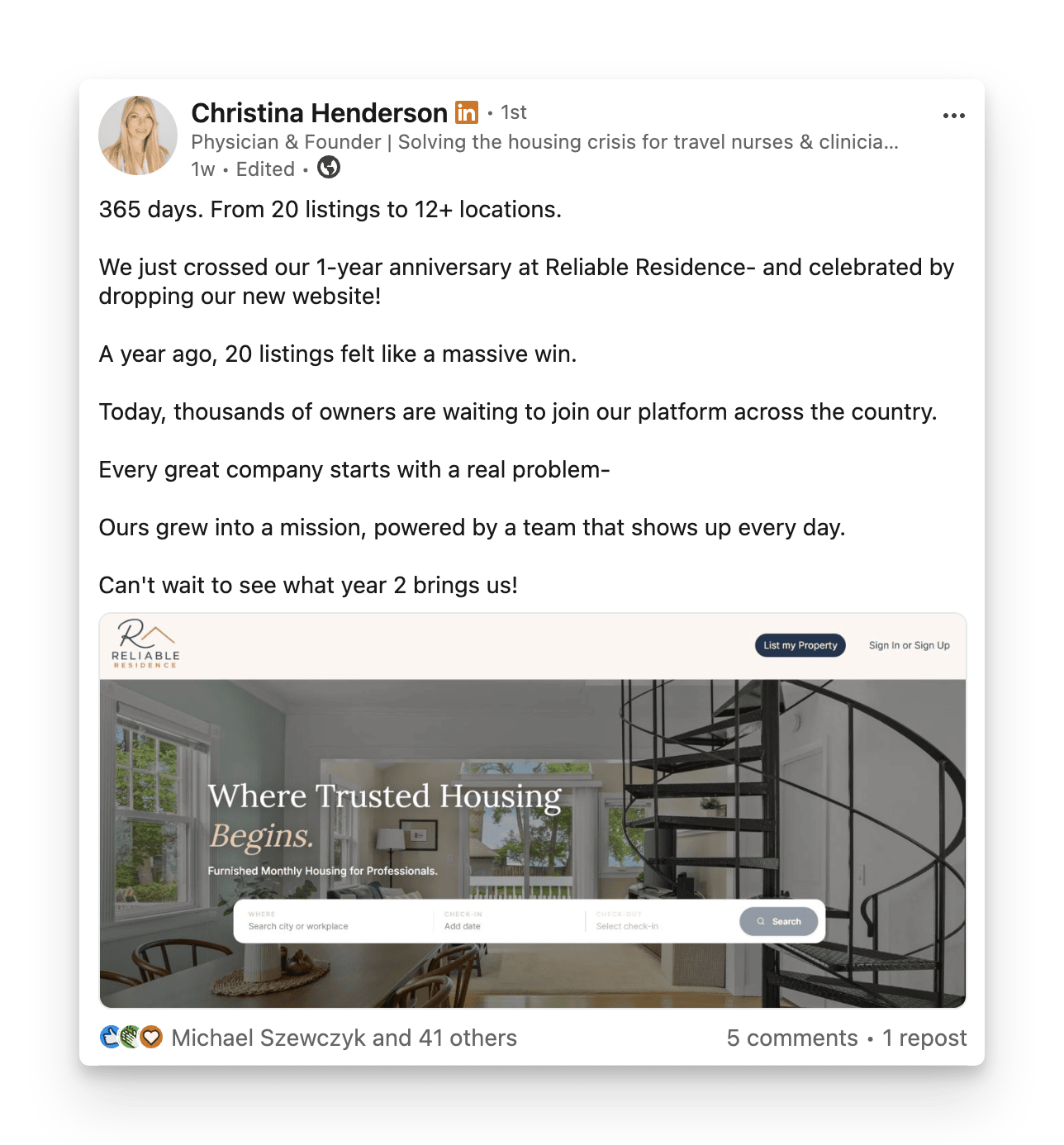
Christina Henderson, D.O. posted a number at the one year mark. Twenty listings to twelve-plus locations in 365 days.
That's the kind of line you scroll past and file under "growing fast."
Then I asked her what surprised her most about the year, and she gave me the opposite answer.
A year ago if you told me we would only be in 12 locations I would've laughed. I would've said 'we will be nationwide.' And I'm so glad we are wrong.
I sat with that for a minute. She's not spinning a shortfall. She thinks going nationwide in twelve months would have cost her the thing the company is actually built on.
I first talked with Christina on the day she launched. She was a third-year anesthesia resident at UW-Madison, up at four, in the operating room by 6:30, building Reliable Residence until she went to bed. The company matches healthcare travelers with vetted midterm housing, one to twelve months, the gap that Airbnb is too expensive for and an annual lease is too long for. If you want the origin story, including the cockroaches and the blazer, it's in her episode on solving the healthcare housing problem.
That interview was almost entirely promises. This one is receipts. Here's what a year did to them.
What she got wrong about her own growth
The reason she's glad about twelve is quality, and she's specific about the mechanism.
Being nationwide in that short amount of time means we would've given up the most important thing to us, quality of our housing. By not being nationwide, it's allowed us to take the time we need to vet listings, vet healthcare travelers, and ultimately provide a safe resource for the community.
The hardest markets are not the ones you'd guess. Not the big metros. The small ones. "Rural locations (Marshfield, etc.) are the hardest to get off the ground because there's limited supply and that supply doesn't always meet our standards."
Marshfield was on her list a year ago. It's still hard. That's a more useful data point for anyone building in this state than another growth chart.
The part that never made it to the platform
When we recorded, she had just flipped from hand matching every traveler to a real platform. I wanted to know what the platform got wrong that hand matching got right.
Her answer is that she never fully stopped.
I still hand-match on occasion because it brings a personal touch to business. I get to learn more about the healthcare traveler and have a genuine conversation and they feel like somebody cares about where they live for that period of time. No amount of personalization of a website can replace that human interaction.
And it's not just her doing it. "We encourage all of our employees to pick up the phone and call travelers or owners because it's a much better approach to solving an issue."
Pick up the phone. It's not a strategy anyone writes on a slide. It's the thing she chose to keep after automating everything around it.
What happened to the founder stamp
A year ago she walked through every single unit herself before it went live. I asked if that was still true at twelve-plus locations, because it obviously couldn't be.
It isn't, and she says so plainly.
I have not personally walked through every unit. Tyler and I would personally walk through units early on but as we grew and became busier we hired out contractors to help us vet units.
What replaced it is more interesting than the fact that it broke. They vet every owner's first unit. If that one comes back clean, well maintained, and safe, subsequent units from that owner skip the walkthrough. A checklist holds the standard steady across whoever is doing the walking.
So the founder stamp became a first-unit test plus a checklist. That's most of what scaling a quality bar actually looks like, and almost nobody describes it out loud.
The number they celebrated that nobody else would
I asked for a number she and her co-founder celebrated that would mean nothing to an outsider without an explanation.
Thirty-three percent.
We have a 33% repeat tenant rate, that's AMAZING! We couldn't believe it. Most travelers move to another city after their contract is completed, and since we don't serve the entire US we can't be a source of continuity. So you can imagine our surprise when we learned that ⅓ extend their stay or book another place with us.
Read that against the twelve locations. A third of their travelers come back even though the company usually isn't in the next city those travelers are headed to. The small footprint should have made repeat business nearly impossible. It didn't.
That's the quality argument, showing up in a number instead of a value statement.
What a year of 4 AM actually cost
The sleep answer is the obvious one, so I asked what she gave up that nobody sees.
Tyler and I have given up a lot to run our startup. We've sacrificed vacations, exercise, meal prep, house repairs, etc.! Lately we've been able to find a better balance. We realized we need to be our best selves in order to lead a team that deserves nothing but greatness.
Note what moved her, because it wasn't burnout advice. It was having a team. Michael Ceely and I got into that pattern on the show, and it lines up almost exactly with helping founders get out of their own way.
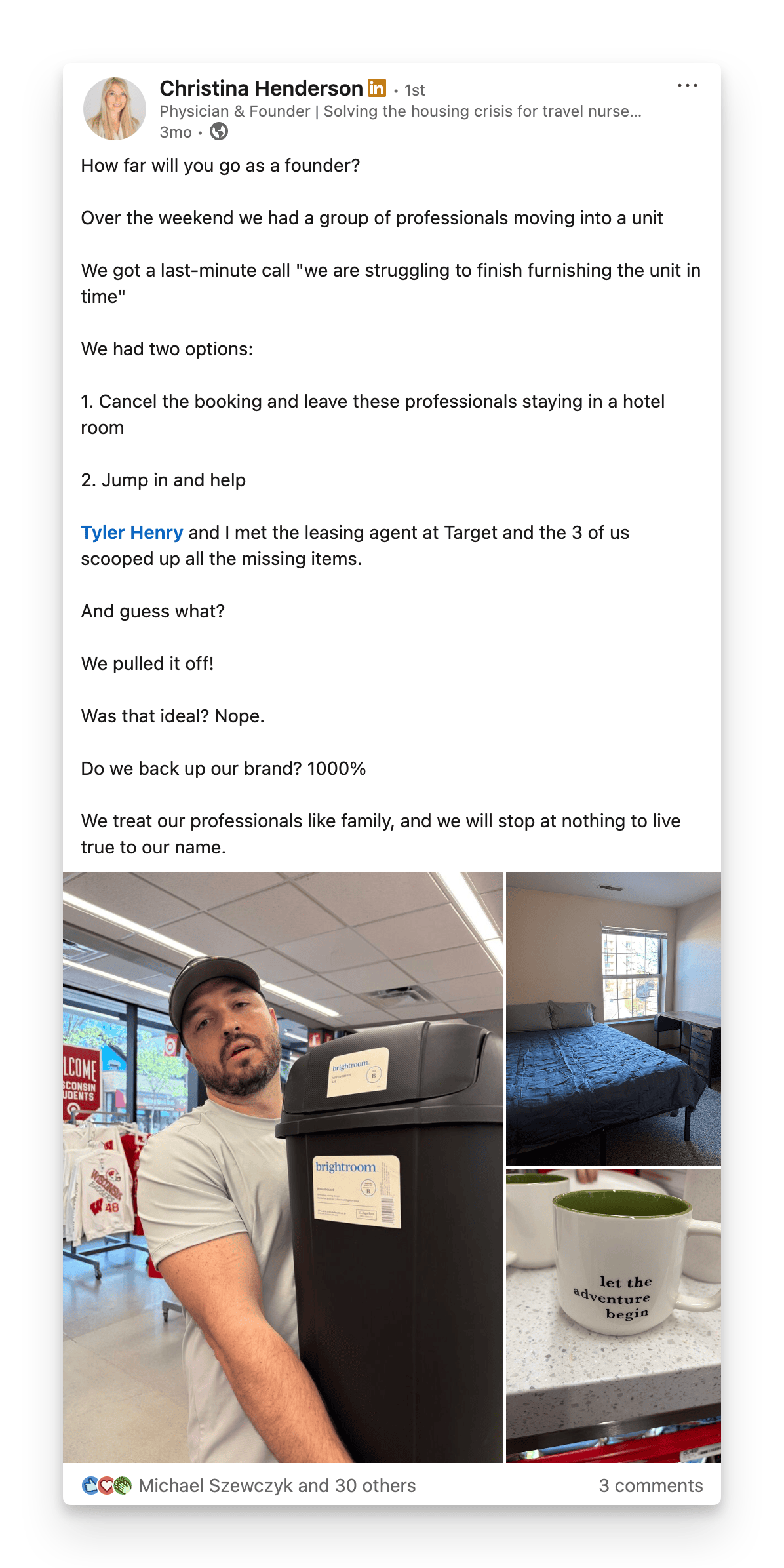
She's also honest that she thought about stopping. "I think any founder would say there's been moments of 'it would be easier if...' But easy isn't in our blood."
And the pitch never got easier either. She's still pitching landlords and hospital systems. She still hears no all the time, "and that's fine because it motivates me to figure out why and problem solve so that the odds are in my favor for the next pitch."
So where does the healthcare founder community stand?
A year ago she told me she wanted to start a meetup for healthcare people who want to build. It exists. It also changed shape.
Monthly became quarterly. Reliable Residence renters meet up at a restaurant or a park to connect with other people living temporarily in Madison. "It's a source of connection for those so far away from home."
Quarterly is not a failure. Quarterly is what a real thing looks like when the person running it also has an operating room schedule. Angela Damiani makes a version of this case about building belonging in startup communities, and the short version is that consistency matters more than frequency.
The mentoring is happening too, one person at a time. A medical student emailed for an intro, they met over Zoom, and she asked the question Christina gets more than any other: how do you balance medicine and entrepreneurship?
I shared that it's very hard but so worth it. There is no better way to gain insight on your solution than to be surrounded everyday by the people using it.
That's the whole clinician-founder argument in two sentences. You are standing inside the problem all day. Most founders pay a fortune in customer discovery to get where you already are.
Which is why her answer to the systems question is worth reading twice, especially if you run one.
Most physician founders wait until their forties or fifties. Only about 5% of physicians ever start a company at all. I asked what one concrete thing a Wisconsin health system or medical school could change to move that.
Culture. We need to create a culture that supports healthcare professionals solving major healthcare problems. Innovation can't be seen as exclusive to those 'established in their careers,' it needs to start early. It needs to start with undergraduates and medical students.
That's not a program request. It's a permission request, and permission is cheaper than a program. UW-Madison is pushing at the same problem from the research side, which Jon Eckhardt laid out in the Founder Forward vision for UW-Madison. Creative Destruction Lab runs a Health and Wellness stream in Wisconsin too, and Kai Heineman explained how CDL builds startups without taking equity when we talked. The doors exist. Med students mostly don't know they're doors.
What Wisconsin gave her, and what it costs
She started the business plan in Silverthorne, Colorado. She incorporated in Madison and calls the company a local backyard operation.
The most surprising thing Madison gave her was regulation.
Madison has very strict short term rental laws which helped us get off the ground because if AirBnBs were on every corner I don't know how far we would've gotten early on.
I've never heard a founder credit a city ordinance for their early traction. It's a real answer.
She won't name mentors, on purpose. "I won't name names because honestly there's too many to count. All of our mentor's efforts have amounted to incredible progress and we certainly didn't do it alone."
And then the hard part, which she volunteered without much prompting.
Not being taken as seriously as someone from the Bay area is hard. There are real biases like this out there and sometimes those can feel heavy as a company. Luckily, we don't give up easily and we've always been able to hold our own.
Anyone who has raised or sold from Wisconsin knows that weight. It doesn't go away with a good quarter. It's a tax you pay on every first meeting.
Should you build it now or wait?
I closed by asking what nobody had asked her this year. She had one ready, and it's the question she thinks most people are actually sitting on.
My answer is always now. Don't let someone else build what you've already determined needs fixing. You're in residency? That's fine. You have kids at home? That's ok. Not enough savings? You'll figure it out. Just take the first step.
Twelve locations instead of fifty. Quarterly instead of monthly. A checklist instead of the founder in every doorway. Every one of those is smaller than the plan, and the company is better for all of them.
Progress over perfection, one more time, with receipts.
If you're a clinician sitting on a problem you already know how to describe, you're further along than you think. Follow what Reliable Residence is building next, then come meet the people doing the same thing around the state. The Startup Wisconsin Podcast is full of them, and the statewide events calendar will put you in a room with a few this month.