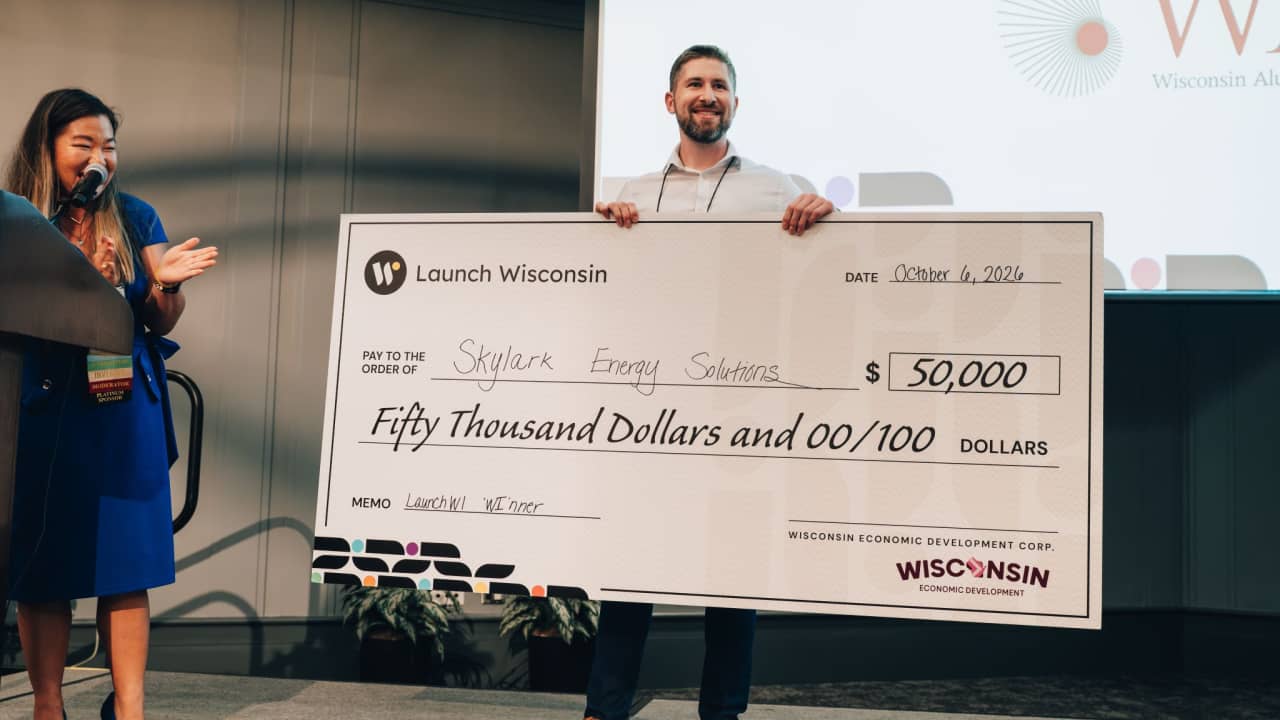
Update: Skylark Energy Solutions, one of the 13 deep tech semifinalists below, won the Launch Wisconsin 2026 grand prize. Before that, the judges picked the 12 finalists, the Diligent Dozen.
Fifty-two startups advanced to the semifinal round of the 2026 Launch Wisconsin contest on July 27. Scan a list like that and your eye goes straight to Madison and Milwaukee.
Twenty-three of them are there. The other twenty-nine are not.
That is the part worth sitting with. By my count of the published list, 19 semifinalists are based in Madison and four in Milwaukee. Everything else comes from Tomah, Lake Tomahawk, Williams Bay, Big Bend, Marshall, De Pere, Green Bay, Oshkosh, Kenosha, and a dozen other places. One entry, LASK, is listed as international.
The Wisconsin Technology Council put it more diplomatically. "Trends reflected in the top 52 entries match up well with Wisconsin's traditional and emerging strengths," said Gary Frings, chairman of the Tech Council. "Good ideas come from all high-growth sectors of the economy and from all corners of the state."
He is right. But the list makes the point harder than the quote does.
So what actually changed this year?
A few things, and they are easy to miss if you have been reading these announcements for years.
The contest has a new name. Launch Wisconsin was the Wisconsin Governor's Business Plan Contest until this cycle. It has a new calendar too, moved from a winter application window to spring.
And the categories are different. For years the four buckets were advanced manufacturing, business services, information technology, and life sciences. This year they are consumer tech, deep tech, enterprise tech, and health tech.
That last one is not just a rebrand. It is a bet on what the state is actually building.
Deep tech filled 13 slots in year one
Here is the breakdown of the 52: consumer tech 15, deep tech 13, enterprise tech 12, health tech 12.
Deep tech had never been a category before. In its first year it drew the second-largest field.
Look at what is in it. Skylark Energy Solutions out of Madison, working on pulling more capacity out of the power grid. SATURN SOILSENSE on advanced soil monitoring. Subsurface IQ. Autonomous Materials Labs in Mequon. Alluxion Biosciences in Marshall. OndaMetrics and VisionSIM in Madison.
Grid capacity, soil sensing, materials science. That is a category that would have been split awkwardly across advanced manufacturing and life sciences a year ago. Now it has its own lane, and 13 companies walked into it.
If you want the clearest recent proof that Wisconsin can hold onto a deep tech company, look at what Realta Fusion's decision to stay in Madison actually turned on. It was not the incentive check.
The rest of the field spans precision guidance for small uncrewed aircraft, smart vending machines, AI-powered financial tools, and platforms turning fragmented medical data into something a clinician can actually use. That last problem is one a Madison founder went deep on with us in fixing the data problem slowing down life-saving drugs.
Three from Northeast Wisconsin
Three semifinalists come from the northeast corner: eBombo in Green Bay, SimpleAudit in De Pere, and Advanced Integration & Measurement in Oshkosh.
Three out of 52 is not a victory lap. But Oshkosh is worth a second look, because Phoenix Aid won the whole thing last year with a patented nano-composite dressing for chronic wounds and is putting production in Neenah.
Two years, two Oshkosh entries deep in this contest. That is a pattern starting, not a coincidence.
Green Bay founders solving unglamorous industrial problems is its own throughline around here. Another one is automating the paper trail in manufacturing, where the hard part turned out to be change management, not the technology. The next group is being pointed at the same problems: a student hackathon in Green Bay runs an Industrial track aimed at supply chains, manufacturing, and workplace safety.
One name shows up twice
Strudel, from Madison, won the information technology category in 2025. It is back on the 2026 list under enterprise tech.
We wrote about Kristin Isaac's company earlier this year in three real AI deployments Wisconsin manufacturers should know about. The short version: 95% of technical issues have already been solved by someone inside the company, and Strudel surfaces that answer before the knowledge retires out the door.
Shepherd Traffic made the finalist round last year too, and it is here again in deep tech.
Coming back is its own signal. These contests reward companies that keep showing up and keep sharpening the same story, and the judges see the same names improve year over year. That is most of the value of entering, honestly. The prize is nice. The forced clarity is nicer.
What happens between now and October
The 52 move into Phase 2, where each one records a five-minute pitch for the judges. A panel of roughly 70 judges organized through the Tech Council scored the entries to get here, drawn from angel and venture groups across the Upper Midwest: Golden Angels, Milwaukee Venture Partners, NEW Capital Management, Idea Fund of La Crosse, WARF Ventures, Wisconsin Investment Partners, and Valency Fund, among others.
Worth knowing if your company is on this list and about to start hiring: one of those judges spent this summer building a vetted job board and talent network for the startups it backs.
The top 12, the Diligent Dozen, present live at the Launch Wisconsin conference on October 6 at Marquette University in Milwaukee. Category winners and the 2026 grand prize winner get named that day.
Note the venue. This used to happen in Madison in June. It is Milwaukee in October now, right in the middle of Wisconsin Tech Month.
Around $3.1 million in cash and in-kind prizes have gone out over the life of the contest, everything from office space and legal work to accounting and marketing support. The Wisconsin Economic Development Corp. is the major sponsor and has been since 2004.
What you can do with this list
Read the 52 names. Find the one closest to you geographically, or closest to the problem you know something about.
Then do the small thing. An intro. A customer conversation. An hour of feedback on a pitch deck that is about to get recorded.
There is a natural place to start. Forward Fest runs August 17 to 21 in Madison, and our field guide to the events worth building your week around will get you in a few of the right rooms. After that, the statewide events calendar is the fastest way to find the one closest to you.
Twenty-nine of these companies are building somewhere without a dense support network within driving distance. The judges will do their part on October 6. The rest of the ten weeks between now and then belongs to the rest of us.
Sources: Wisconsin Technology Council, MKE Startup News, and In Business Madison.