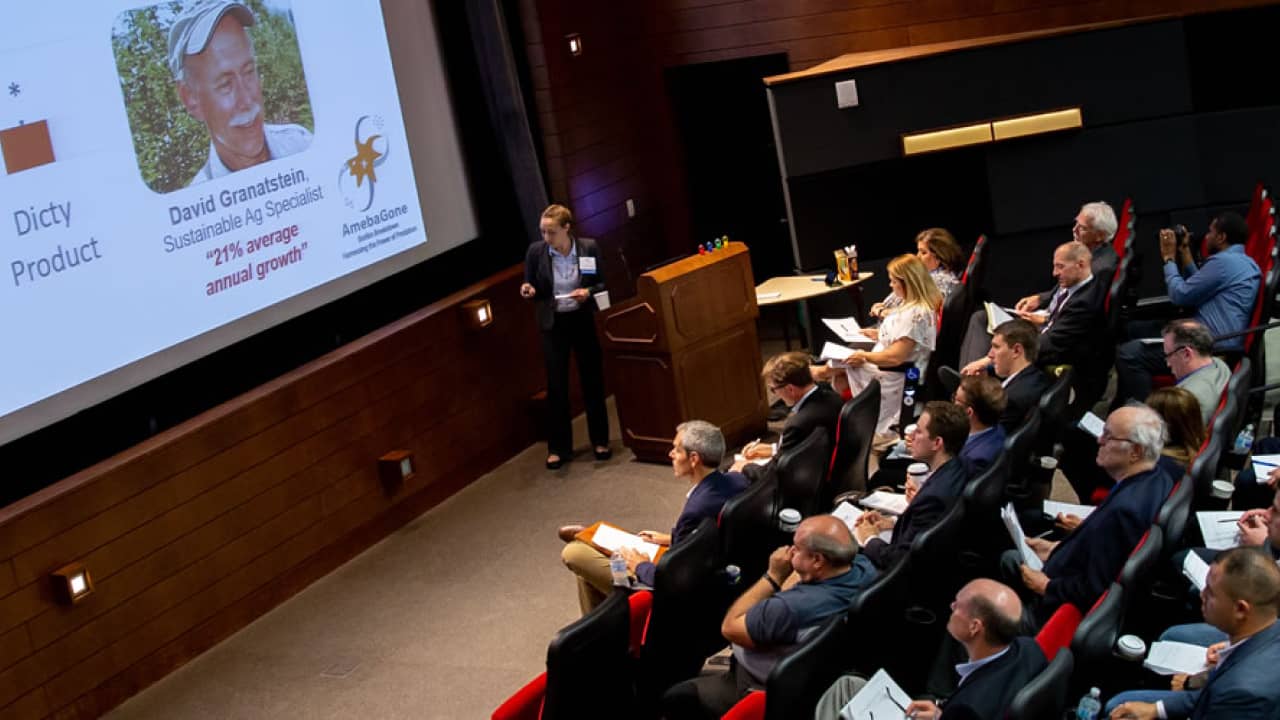
Most pitch nights run the same way. A founder walks up with an idea, and a room full of investors decides whether it's worth backing.
On October 14 in Milwaukee, that runs in reverse. The technology is already built. It came out of years of research at Marquette University, UW-Milwaukee, the Medical College of Wisconsin, and Versiti. It has intellectual property protection in place. What it doesn't have yet is a founder.
That's the premise of Idea to Enterprise Pitch Night, hosted by Founder Factory at the UWM Lubar Entrepreneurship Center. Jessica Silvaggi, president of the UWM Research Foundation, pitched it on LinkedIn about as directly as you can: want to start a company but don't have an idea? Come grab one of theirs.
Why do good university technologies sit on the shelf?
In January, I sat down with Jessica on the Startup Wisconsin Podcast to talk about turning UW-Milwaukee research into startups. I asked her where the entrepreneurs behind university startups usually come from.
"Generally it's been the inventor. We don't have enough people reaching out and saying, hey, do you have any technologies that I can take a look at?"
So the professor who invented the thing ends up as CEO, even when CTO would be a much better fit. Big companies tend to wait until a startup has traction before they get interested. And Jessica pointed out that Wisconsin angels often want to see traction before they write a check, too.
The result is a lot of good research with nobody to build a company around it.
Near the end of that conversation, she mentioned a project her team was working on with partners across Southeast Wisconsin:
"We're working on an idea to create a new sort of accelerator pathway with various verticals. Not reinventing the wheel."
A month later, it had a name.
What is Founder Factory?
Founder Factory is a Southeast Wisconsin startup program that pairs founders with university research, mentoring, and up to $50,000 in seed funding that doesn't take equity.
It launched in February 2026 with a $772,000 grant from the first round of WEDC's Ignite Wisconsin program. The Universities of Wisconsin Center for Technology Commercialization (CTC) leads it, alongside the UWM Research Foundation, the UWM Lubar Entrepreneurship Center, the Milwaukee Tech Hub Coalition, and Midwest Founders Community.
Behind them sits a 20-member consortium that includes Marquette, MCW, Versiti, Forward BIOLABS, Golden Angels Investors, NVNG Investment Advisors, and more. If you've listened to our episode on how Forward BIOLABS gives Wisconsin biotech founders a running start, you already know one of the pieces.
The gap it's built to close has a name, too. Margaret Ramey, director of CTC, called it the messy middle:
"Wisconsin has world-class research and entrepreneurial talent, but too many high-potential ventures stall in the 'messy middle' between discovery and scale."
If you're still working out whether venture capital is even the right fit for your company, early money that leaves your cap table alone buys you time to find out.
The program is industry agnostic but leans into biohealth early, in line with Wisconsin's federal Biohealth Tech Hub designation.
Brian Walsh, Founder Factory's director and a senior technology commercialization manager at UWMRF, said the design came out of a lot of listening first:
"Through extensive stakeholder interviews and ecosystem analysis, we heard loud and clear that too many promising founders in Southeastern Wisconsin were falling through the cracks between early discovery and true investment readiness."
Is Founder Factory working yet?
It's early. The program isn't a year old, so nobody should be calling it a success story. But there are signals.
In May, Founder Factory ran the first version of this pitch night. Tech transfer leaders from all four institutions pitched a dozen technologies, everything from a next-generation Lyme disease vaccine to on-device cybersecurity for robots and drones.
One pitch that night was Versiti's lipid-lowering peptide for cardiovascular disease. Founder Factory introduced the research team to Sean Zuckerman, a commercialization advisor with more than 16 years in IP strategy and SBIR-funded ventures. He's now listed as an advisor on the team's STTR application.
In August, Founder Factory picked its first pre-accelerator cohort: five companies out of 24 applicants. They're a good picture of the range:
- UbiWhite, a clip-on smartphone device with an AI-powered app that delivers a white blood cell count in about 60 seconds. No needles, no lab.
- HydraCore Technologies, a patented wearable vest that adds dynamic resistance for rehab, healthy aging, and fitness
- SeeMed, a Wauwatosa company using virtual and augmented reality to plan and guide medical procedures
- Iova Labs, building FREVR, a microscope upgrade that holds focus at nanometer-scale precision
- Built-N-Bioassays, which uses engineered algae, computer vision, and machine learning to screen chemicals and test water quality
Walsh was at the May event, and he named what made the format different:
"What makes nights like this different is that you're not just hearing ideas, you're seeing pathways."
What technologies are pitched at Idea to Enterprise Pitch Night?
The fall lineup covers six areas:
- Brain health and neurotechnology
- Medical devices and digital health
- Drug discovery and therapeutics
- Industrial automation and manufacturing
- Aviation and advanced propulsion
- Environmental and life science innovations
Founder Factory has published briefs on the technologies in its pipeline, and they're worth a skim before you go.
I couldn't tell you how most of these work at the molecular level. And that's kind of the point. The science has been done by people who spent years on it. What these technologies need now is the business side: someone who can talk to customers, build a team, figure out pricing, and raise money.
Who should go to the October 14 pitch night?
Pretty much anyone who's been waiting for a reason to get closer to a startup:
Ilya Avdeev, who leads the Lubar Entrepreneurship Center and co-leads the pre-accelerator, put the philosophy this way: great founders "don't just need ideas." They need a coordinated system that helps them test, build, and scale.
Founder Factory is one of those systems. It's not the only door. Programs like Creative Destruction Lab in Madison take a different approach, and that's a good thing. More doors is the point.
Idea to Enterprise Pitch Night: date, time, and location
Idea to Enterprise Pitch Night: University Innovations Ready for Launch
Already have an idea of your own? Founder Factory is also taking letters of intent for its next pre-accelerator cohort. LOIs are due October 23.
Jessica closed her post the same way:
"Maybe you don't need a new idea. Maybe you just need access to a great one."